|
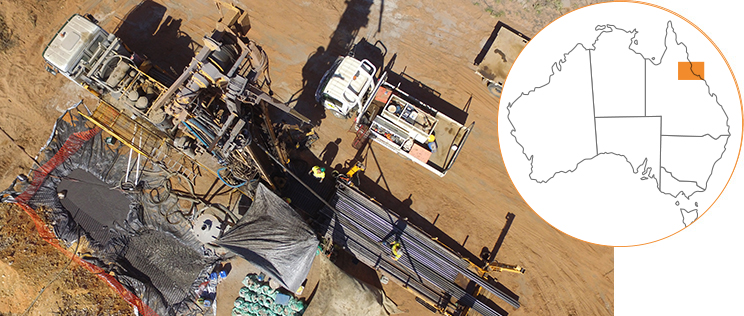
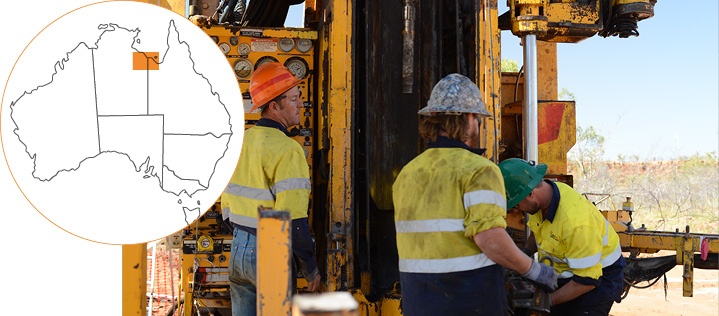
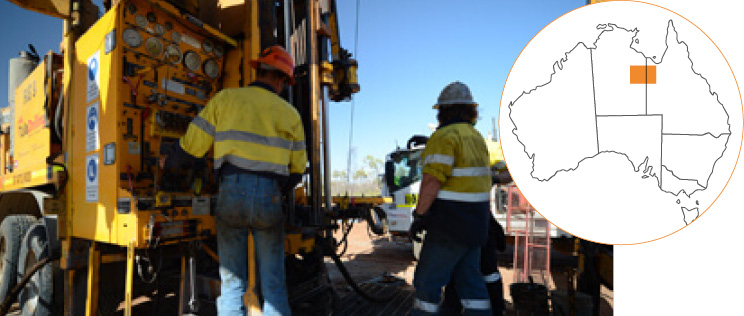
The Dajarra copper (and lead-zinc-silver) project is situated south of the small township of Dajarra and approximately 150km south-south-west
of Mount Isa. The project is made up of six granted exploration permits (EPM15040, EPM15046, EPM15219, EPM15328, EPM15329 and EPM16029)
and two exploration permit applications (EPM16995 and EPM18542) which total 1520 square kilometres.
The Dajarra area is interpreted by Superior to be offset from the Mount Isa area (Southern Isa Offset). If so the Dajarra area
may contain the original southern extensions of the Mount Isa host rocks.
Many of the elements of Superior's copper exploration model exist in this project area.
The favourable features of this project area include:
- The presence of extensive areas of basic volcanics in outcrop and in covered areas as evidenced in the airborne magnetics in the covered
southern portion of the project area.
- The existence of areas of magnetite destruction which is apparent in the airborne magnetics over outcropping
basic volcanics and also over basic volcanics in covered areas.
- The presence of substantial blocks of sediment faulted against basic volcanic sequences.
Most of the prospective sediment blocks lie beneath covered areas.
- The presence of outcropping fine grained pyritic dolomitic shales probably equivalent to the host rocks of the Mount Isa deposits
- The interpretation that the rocks in the area are the faulted offset of those that host
the Mount Isa deposits (the Southern Isa Offset).
- The lack of serious base metal exploration in the area previously.
- The possibility of ‘leakage’ of lead and zinc into the Cambrian rocks in the Alderley area.
The prospective Proterozoic rocks in much of the Dajarra Project area lie under shallow Mesozoic and Cambrian sedimentary cover.
Superior's approach to exploration of this area has been to use high-quality airborne magnetics, radiometrics and other datasets to identify
areas of possible Mount Isa Group (host of the Mount Isa deposits) equivalents in the area. These areas have been reconnaisance mapped
in the field to determine whether they contain Proterozoic outcrops and to identify the more prospective parts of the tenement areas.
A heliborne electromagnetic (EM) (VTEM) survey was completed over the more prospective areas in July 2007 both to confirm that prospective
rocks were present and to locate potentially mineralised areas for drill testing.
The results of this work program to date are that two new areas of outcropping Mount Isa Group equivalents, which have not previously been identified,
have been located (Elizabeth Prospect and RFZ Prospect). As well as these areas a number
of other areas with potential have also been identified for further work.
The July 2007 VTEM survey shows the Elizabeth, RFZ and Mungeraba prospects as high-priority EM anomalies:
The Elizabeth Anomaly lies within an area of Mount Isa Group sediment equivalents south of the junction of Rufus Creek and Sulieman Creek.
The RFZ Anomaly lies within an area of Mount Isa Group sediment equivalents located on the southern extension of the Rufus Fault Zone.
The Mungeraba Anomaly lies under Cambrian cover and to the south and along strike from the Mount Isa Group sediment equivalents at the RFZ Prospect.
Elizabeth Prospect
The Elizabeth EM Anomaly, which lies within EPM15040, is considered a high-priority target area. It was originally outlined on five
consecutive flight lines spaced at 500m intervals in the July 2007 VTEM survey.
Geotech Airborne Pty Ltd completed more detailed VTEM (100m spacing) over the Elizabeth Anomaly in December 2007
to better detail the anomaly and to determine its full extent.
The anomaly has a length in excess of 2000m, a width up to about 400m and it lies at a depth in excess of 100m. It does not outcrop.
Most of the area of the Elizabeth Anomaly is covered by red sandy soil derived from weathering of the basal sandstone unit
of the Cambrian sedimentary cover. In the northern portion of the anomaly subdued outcrops of strongly ferruginous (iron-rich)
Proterozoic siltstones indicate that the host sediments of the anomaly are probably Mount Isa Group sediment equivalents.
Scattered outcrops of ferruginous sandstone which belong to the Cambrian cover sequence indicate that iron is enriched on the
Cambrian unconformity. It is uncertain at this stage if the iron in the strongly ferruginous Proterozoic siltstones is due
to iron enrichment on the unconformity or is derived from original pyrite in the siltstones.
Broadly the geological setting of the Elizabeth Anomaly is similar to that at Mount Isa where the Mount Isa Group
sediments containing the Mount Isa deposits are faulted against basalts and quartzites along a major north-south fault.
Exploration completed at Elizabeth to date, in addition to the VTEM survey, includes geological mapping, geochemical sampling,
gravity, drilling and down-hole electromagnetic surveying.
Conductivity modelling of the VTEM survey data indicated that a strong conductor existed in the Elizabeth Prospect area.
The conductor which had an approximate length of 4km lay at a depth in excess of 100m in the northern part of the prospect area
and became increasingly deeper towards the south.
The gravity survey showed a pronounced gravity low feature in the northern part of the Elizabeth Prospect area where
a pronounced circular feature existed on the ground (Elizabeth Circular Feature). Further gravity low features were defined
in the eastern part of the prospect area (Eastern Gravity Low).
Data from the gravity survey was subjected 3D density modelling to produce a 3D density model of the area. An intense density low
was outlined at the Elizabeth Circular Feature. As this density low feature was 'carrot shaped' it was considered at the time to
possibly reflect a diamond pipe. Smaller but still significant density high features were coincident with the conductor outlined
from the VTEM survey.
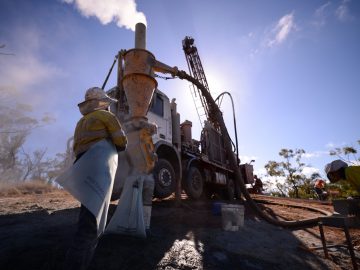
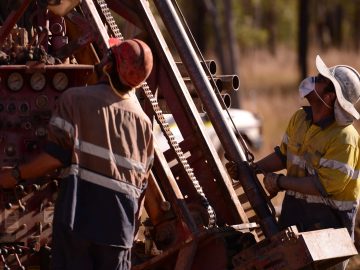
A total of 16 drill holes have been completed in the Elizabeth prospect area. The holes have targeted both the conductors
from the VTEM survey and the gravity (density) low features from the gravity survey.
Most of the drilling of the conductors has been completed on two sections at 1km separation. This drilling shows that,
at least in the northern part of the Elizabeth prospect, the conductive bodies are graphitic siltstones which are
often strongly dolomitic. Some low-grade copper, lead and zinc mineralisation was intersected in the drill holes.
Drill hole EZ006 intersected 24m of silicified siltstone containing quartz-dolomite breccia
which is similar to the quartz-dolomite breccia (silica-dolomite) which hosts the copper mineralization at Mount Isa.
No drilling has been completed in the southern part of the Elizabeth Prospect area where the conductors are at greater depth.
Two holes were drilled into the density low feature (Elizabeth Circular Feature) in the northern part of the Elizabeth prospect
area. These holes failed to intersect potentially diamond bearing hosts. The deepest of the holes (EZ009), which was drilled into the
centre of the circular feature, intersected 176m of lake sediments overlying 75m of clayey slump breccia above a 30m cavity overlying
184m of leached collapse breccia. The hole terminated in oxidised dolomite at 514.7m. The second hole intersected 50m of lake
sediments followed by strongly ferruginous leached and partly brecciated material to 90m which showed anomalous copper values.
The hole terminated in oxidised dolomite at 160m.
The Elizabeth Circular Feature is interpreted to be an intensely leached zone where leaching has produced sub-surface
cavities into which the overlying rock has collapsed creating a deep surface depression which became a lake. The cause
of the leaching is uncertain but one possible explanation is that acid generated by the oxidation of pyrite (or other
sulphides) may have dissolved substantial amounts of dolomite in the country rock.
Two shallow RC drill holes into the Eastern Gravity Low on the eastern side of the Elizabeth Prospect indicated that this
gravity low was also reflecting lake sediments above a strongly leached zone. To test the area beneath the Eastern Gravity Low
hole EZ007 was extended from 300m to 624.7m. The hole intersected a substantial amount of dolomitic siltstone and dolomite
from 260m to 624.7m but did not intersect significant mineralisation.
The Elizabeth Prospect contains a large area of prospective sediments which are interpreted to be equivalent to the Mount Isa Group
which hosts the mineralisation at Mount Isa. Drilling indicates substantial amounts of prospective dolomitic siltstone and dolomite
which are not evident on the surface. The intensive leaching at the Elizabeth Circular Feature is suggestive of large quantities of
pyrite in the area as are strongly ferruginous siltstones to the north on this area. The southern portion of the prospect area which
shows deeper VTEM anomalies has not been drilled. The Elizabeth Prospect therefore remains as a high-priority target area for copper
and lead-zinc-silver mineralisation.
RFZ Prospect
The RFZ VTEM Anomaly lies in the eastern portion of the RFZ Prospect. The anomaly exists on six of the flight lines from the
July 2007 VTEM survey. The flight lines were spaced at 250m intervals and therefore the anomalous area has a length of 1.5km.
The stronger part of the anomaly occurs on two lines.
Modelling of the anomaly indicates that the conductive source is an easterly dipping body.
The geology of the area consists of Proterozoic siltstones and shales with some surficial ironstone bodies
which may reflect pyritic sediments.
Soil sampling at a spacing of 200m X 50m has been completed over the RFZ Prospect. This has outlined two low order copper
anomalies over fine grained Proterozoic sediments. One of the anomalies corresponds with the RFZ EM Anomaly and one is in the
south-western corner of the prospect area.
Drilling of four holes into the RFZ EM anomaly was completed in December 2007. Assay results do not indicate significant base metal results.
The RFZ prospect remains as a moderate-priority target area. It is a large area of prospective sediments which are interpreted to be
equivalent to the Mount Isa Group.
Work on the area has been suspended while exploration is carried out on higher-priority prospects.
Mungeraba Prospect
The Mungeraba Prospect was located as a VTEM Anomaly by Superior's July 2007 VTEM survey. The anomaly lies approximately
7km south-southwest of the RFZ Prospect. No work has been completed on the area previously.
The stronger part of the anomaly occurs on two VTEM lines spaced at 500m intervals but the anomaly has a total strike length
of about 1.5km. Conductivity modelling indicates that the anomaly has an estimated source depth of about 100m and that
the conductive source of the anomaly is a synclinally folded body.
Whilst the area is covered by Cambrian sediments with an estimated depth of about 100m, and little is known about the
Proterozoic rocks beneath the Cambrian cover, the anomaly source is most probably hosted by the Mount Isa Group
sediments which the airborne magnetics show as extending under cover from the RFZ Prospect area.
A gravity survey of the RFZ to Mungeraba prospects area was completed during 2009.
The gravity survey shows a complex gravity anomaly at Mungeraba which consists of a strong broad gravity low with a
central north-south striking gravity high through the low.
Three dimensional density modelling of the gravity data shows a central density high surrounded by a density low
similar to that indicated by the raw gravity data. In the absence of any subsurface information the reason for the complex
density anomaly is uncertain. The preferred interpretation is that the density high is reflecting sulphides
and the density low is reflecting leaching on the host rocks by acid due to oxidation of sulphides.
The modelled density data shows the synclinal structure as modelled from the VTEM data.
Drilling is the next phase of work planned for the Mungeraba Prospect. Native Title clearances have been completed and
drilling is scheduled for the dry season in 2010.
With coincident gravity and VTEM anomalies in probable Mount Isa Group sediments the Mungeraba Prospect is considered to be a
high-priority prospect.
Other Prospects
At the Carbine Prospect the July 2007 VTEM survey outlined a high-priority conductive anomaly on one flight line.
More detailed VTEM surveying at 100m spacing in December 2007 better defined the anomaly.
Drilling will be completed on the Carbine Prospect when higher-priority work on other prospects
is completed.
Drilling of the Rundle Prospect (EM anomaly) has been completed. Assay results do not indicate significant base metal results.
Two holes have also been drilled at the Buckingham Prospect. These have intersected magnetic
dolerite which adequately explains the magnetic anomalies at this prospect.
A small gossan has been discovered at the Quita Prospect. Gold anomalies occur in streams to the south of the gossan.
Further investigations will be completed on this area during 2010.
|