|
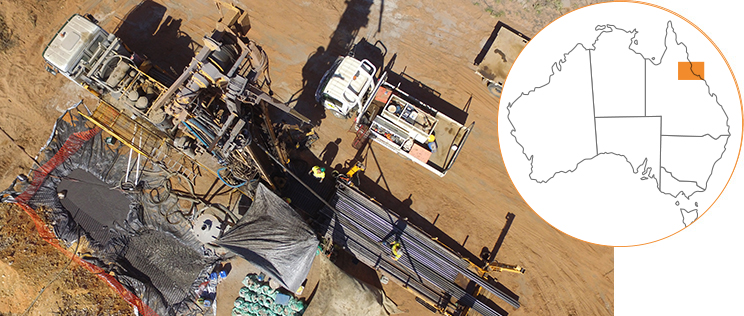
The Victor Project is located some 180 km north-north-west of Mount Isa, 60 km south-south-east of the Century
lead-zinc-silver deposit and 10 km south of the Grevillea lead-zinc-silver prospect. The project consists of one exploration permit
(EPM16028) and one exploration permit application (EPM18840) which cover Proterozoic rocks overlain by Cambrian cover.
The principal target in the area is a copper deposit hosted in the Proterozoic aged Lady Loretta Formation which is roughly
equivalent in age to the sediments that host the copper mineralisation at Mount Isa. Exploration is also targeting lead-zinc and
copper mineralisation hosted within the Riversleigh Siltstone. The Riversleigh Siltstone hosts stratiform lead-zinc mineralisation
to the north of the project area at the Grevillea Prospect.
Kingfisher Copper Prospect
The principal prospect in the Victor Project area is the Kingfisher Copper Prospect which is considered to have potential for copper
mineralization of the Mount Isa style.
The prospect, which is located at 268,700 E, 7,877,300 N (MGA Zone 54), lies approximately 7km east of the O’Shannassy River.
The Kingfisher Copper Prospect area is largely covered by a thin flay-lying cover of Cambrian sediments overlying limited
exposures of Proterozoic Lady Loretta Formation and Shady Bore Quartzite. Extensive copper mineralization is developed
on and beneath the unconformity between the Proterozoic and overlying flat lying Cambrian sedimentary units.
Victor Project Historical Drill Intersections
|
Hole
|
From
|
To
|
Length
|
Cu (%)
|
|
RC92RV25
|
28
|
32
|
4
|
0.47
|
|
RC92RV35
|
20
|
22
|
2
|
2.46
|
|
RC92RV35
|
40
|
54
|
14
|
0.31
|
|
RC93RV45
|
30
|
42
|
12
|
0.33
|
|
RC93RV45
|
46
|
54
|
8
|
0.48
|
|
DD93RV57
|
29
|
48.2
|
19.2
|
0.67
|
|
CRAE drilled 44 holes into the Kingfisher Copper Prospect area largely targeting the outcropping copper mineralisation.
In general intersections from the drilling were narrow and of low grade. Some of the better results from this drilling are
shown in the included table.
The copper mineralisation within the Cambrian sediments occurs largely as disseminated mineralisation within a basal breccia unit
and in some places the copper mineralisation extends a short distance up into the overlying Cambrian limestone units.
Within the underlying Proterozoic aged Lady Loretta Formation copper mineralisation occurs in southeast trending lodes and
breccia bodies hosted by dolomitic siltstone. Because of the extensive Cambrian cover in the area the full extent of the copper
mineralisation is not known but CRAE did locate copper mineralisation in holes drilled about 1.5km south of the outcropping
copper mineralisation indicating that the copper extends beneath the covered area.
KINGFISHER COPPER PROSPECT MINERALISATION
|
|
|
|
|
|
The potential of the outcropping copper mineralisation at Kingfisher has partly been tested by the drilling by CRAE but there are
near surface areas of copper mineralisation that still require additional testing.
The possibility exists that the known copper mineralisation on the Cambrian unconformity is remobilised from deeper copper mineralisation
of the Mount Isa style within the Lady Loretta Formation. This possibility provides a larger target which is more consistent with Superior's
aim of finding a larger copper deposit in northwest Queensland.
Superior completed a detailed gravity survey of the Kingfisher Copper Prospect to determine if there were target areas for copper
at depth as well as the surface copper mineralisation represented by the areas of copper staining. The gravity survey results showed
a prominent gravity anomaly associated with the main area of surface copper mineralisation. This indicated that gravity was
an appropriate method of detecting copper mineralisation in the area. The survey also outlined an additional five anomalies
that could potentially reflect chalcopyrite-pyrite mineralization of the Mount Isa style.
Three dimensional (3D) density modelling of the gravity survey indicated that five of six target areas outlined by the gravity survey
had density anomalies located around depths of about 300m. Based on the density, gravity and other data a program of five drill
holes each to a depth of 400m is proposed to test these five targets.
Harris Creek Prospect
Interpretation of two airborne electromagnetic (EM) surveys completed by a previous explorer in the Harris Creek area
shows a late channel EM anomaly sourced within Proterozoic rocks beneath Cambrian sediments. The anomaly has a length
of about 4km and is located within a package of conductive rocks that can be correlated with the Riversleigh Siltstone.
The anomaly is located within application for exploration permit EPM18840. The area of this EPM is partly within the
high-preservation area of the Gregory 'Wild Rivers' area and this could impact on granting of the tenement
and the work program possible on the area.
|